
Why is your website feedback scattered across Slack, Notion and email?
Parry Gill · Nov 4, 2026 · 6 min read
Quick test. Think of the last round of feedback on your website. Where is it right now?
If you're like most teams, the honest answer is "kind of everywhere". A Slack thread about the hero. An email from your manager with three bullet points. A Notion page someone started and nobody finished. A Jira ticket that says "fix pricing page spacing". And a Downloads folder full of files called Screenshot 2026-10-14 at 3.42.11 PM.
None of those tools did anything wrong. They're each good at their own job. The problem is that feedback about a web page doesn't really belong in any of them, so it lands in whichever one was open at the time.
And it costs you in three ways.
Can you find it when you need it?
Feedback is never needed when it's given. It's needed a week later, when someone sits down to make the change. That's when the hunt starts.
Was the note about the CTA in the design channel or the launch channel? Did Sam send it by email or drop it in the Notion page? You search Slack for "button" and get four hundred results. The screenshot is in your Downloads, probably, under a timestamp that means nothing.
Search tools can find words. They can't find "that thing Priya said about the second card on the pricing page", because nobody wrote it down that way.
Can you reproduce it?
Say you do find it. "The spacing looks off here" plus a cropped screenshot. Okay. Here where?
Which page was it? Was it on mobile? Was a menu open, or a hover state showing? Has the page changed since, so the thing in the screenshot isn't even there anymore? Half of fixing feedback is reconstructing what the person was looking at, and a screenshot in a chat thread throws most of that away.
This is the part that quietly eats developer and designer time. Not the fix. The figuring out what to fix.
Can you tally it?
Then comes the question right before launch. "So, are we done?"
Good luck. You'd need to open every thread and every email and every doc, and figure out what got fixed, what got shot down and what just got forgotten. Sometimes three people flagged the exact same thing in three different places, and now it looks like three jobs. Other times somebody said one really important thing, once, and it scrolled off the top of a channel on a Tuesday.
You don't have a list. You have a pile, split across four apps, and none of them has a "done" button.
Why does it keep happening?
Here's my theory. Website feedback is always about one spot on one page. Slack wants conversations. Email wants messages. Notion and Docs want documents, tickets want tasks. None of them has the faintest idea what page you're on.
So you end up translating. You describe the page in a sentence, or paste a picture of it, and somewhere in that step most of the useful stuff falls out. The page, the element, how it looked, who said it, what happened afterwards. It all gets squashed into a line of text and a PNG.
What if it just stayed on the page?
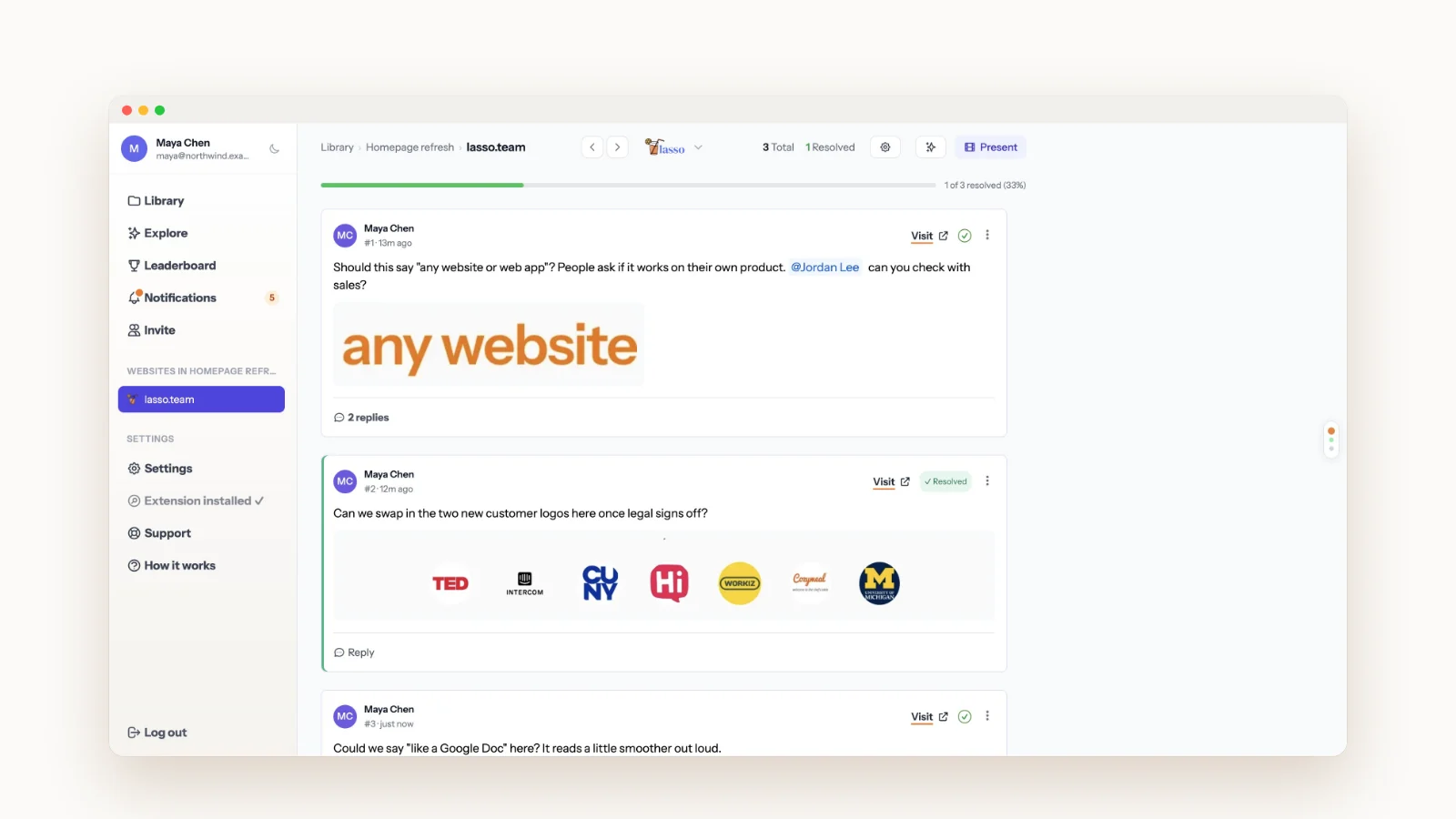
That's basically why Lasso exists. You skip the describing part and comment right on the page.
Click whatever you mean, type, done. The comment sticks to that element, and Lasso grabs a screenshot right then, so if the page changes next week you can still see what was there.
Okay, back to those three questions.
Can you find it? A project's comments all go in one collection. Open the page and there they are, pinned in place. Or hop into the web app and narrow things down by page, by who wrote it, or by a word in the comment.
Can you reproduce it? You kind of don't have to. Each comment already knows its page and its element, and it has the picture. Click one and the page scrolls you right to it.
Can you tally it? Replies and decisions pile up under each comment instead of in some other app. When a thing's handled, you resolve it, and the collection keeps count of done versus left. So when someone asks "are we done?", you can actually answer.
Keep Slack, honestly
I'm not telling you to quit Slack. Please don't, it's great at "hey, something happened".
What changes is the thing you paste in. Each Lasso comment has its own super link. Throw it in a thread or an email and whoever clicks it lands on the live page, scrolled to that comment, with all the other notes on the page pinned around it. Slack pings people. The page holds onto the context.
One place that's actually true
People throw around "single source of truth" a lot. For website feedback it means something pretty simple. When anyone wants to know what was said about a page, there's one spot to look, and what's in that spot is right.
Most teams don't have that. The Notion page says one thing, a Slack thread from later says another, and the ticket was written before either. Which one wins? Usually whoever remembers best.
With Lasso, the collection is that spot. The comment, its screenshot, every reply and whether it's resolved all live together, attached to the page they're about. Change your mind in a reply and the thread shows it. Resolve something and it's resolved for everybody, not just in your head. Someone new joins the project? Hand them the collection instead of six links and a "you'll pick it up".
And because Slack messages, Notion pages, emails and tickets can all carry a super link back to the comment, those tools point at the truth rather than each keeping their own copy of it.
What gets better
The obvious win is time. Less hunting, fewer "which button?" messages, fewer screenshots to crop and label.
The less obvious one is trust. When everything is in one place with a clear done and not done, people stop re-raising the same point just in case it got lost. Reviews get shorter, because the decisions are already written down next to the thing they're about.
And when you need a summary, a brief or a fix list, you can export the whole collection to ChatGPT or Claude in one go, instead of copying from four apps into a fifth.
If your feedback is scattered right now, try it on your next review. Lasso is free to start, and the getting started guide takes about two minutes.